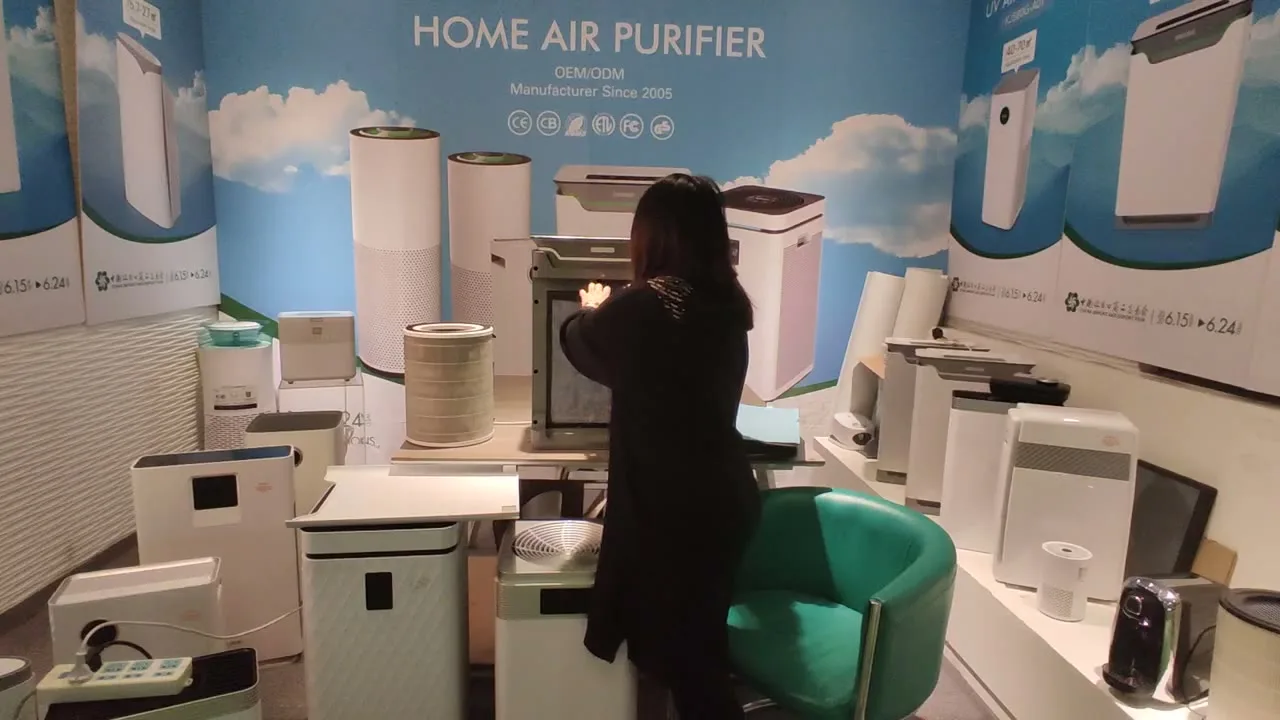
We recently ran a livestream from our Guangzhou showroom where we opened a purifier on camera and pulled its composite filter apart layer by layer. Buyers kept the replay link longer than we expected, so here is the written version — cleaned up, and with the engineering context a sales demo has no time for. If you specced filters on a datasheet alone, this is what the layers actually do.
Why one cartridge instead of four
Older designs stacked separate filters — a pre-filter mesh, a HEPA sheet, a carbon panel — each with its own frame and its own replacement schedule. A composite filter laminates the stages into one cylindrical or panel cartridge. For the end user, that means one purchase, one replacement date, one motion. For your brand, it means one consumable SKU instead of three, which is what keeps a replacement-filter subscription program simple enough to actually renew.
Layer 1: the pre-filter — bodyguard, not hero
The outer mesh catches hair, pet fur, lint and coarse dust. It does almost nothing for air quality numbers on its own; its real job is to keep large particles off the HEPA layer so the expensive media keeps its rated life. When a customer complains a purifier "died in four months," the cause is usually a choked HEPA that a washable pre-filter would have protected.
Layer 2: HEPA — and the grade question everyone asks
The HEPA layer removes fine particulates — PM2.5, pollen, smoke. Grades differ: H11/H12 (95–99.5% at MPPS) for home and bedroom models, H13 (99.95%) where the use case justifies it — medical-adjacent, baby rooms, wildfire markets. H13 is not automatically the right spec: it costs more, adds air resistance, and forces a stronger (louder) fan to hold the same CADR. For most retail home SKUs, H12 is the engineering sweet spot; we covered the marketing-versus-physics side of this in True HEPA vs. "HEPA-type".
Layer 3: honeycomb activated carbon — the smell layer
Odors are chemistry, not particulates, so they need a different mechanism. Our carbon stage uses a honeycomb matrix filled with activated carbon granules — high surface area, low pressure drop. This is the layer that works on formaldehyde from new furniture, benzene and TVOCs from renovation, and pet and cooking smells. If your market brief includes "new apartment" or "pet family" positioning, this layer's fill weight is where the claim is won or lost — ask for the carbon weight in grams, not the word "carbon" on a box.
Layer 4: cold catalyst — VOC breakdown without UV
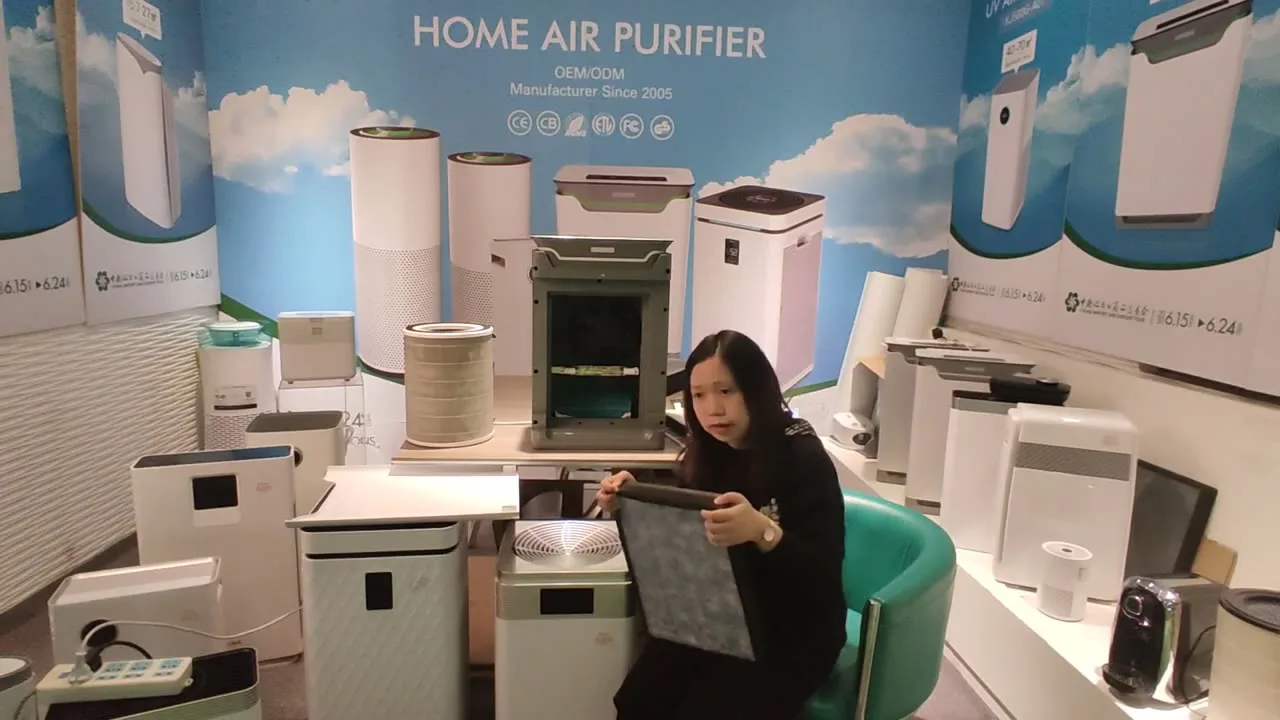
The last stage is a cold catalyst coating that decomposes residual VOCs at room temperature. Buyers often confuse it with photocatalyst (TiO₂), which needs a UV lamp to activate — adding a lamp, its power draw, and its replacement schedule to the BOM. Cold catalyst works passively, so machines without UV hardware still get VOC reduction. For markets where users never replace a UV lamp, this is the more forgiving design.
Why some machines carry two filters
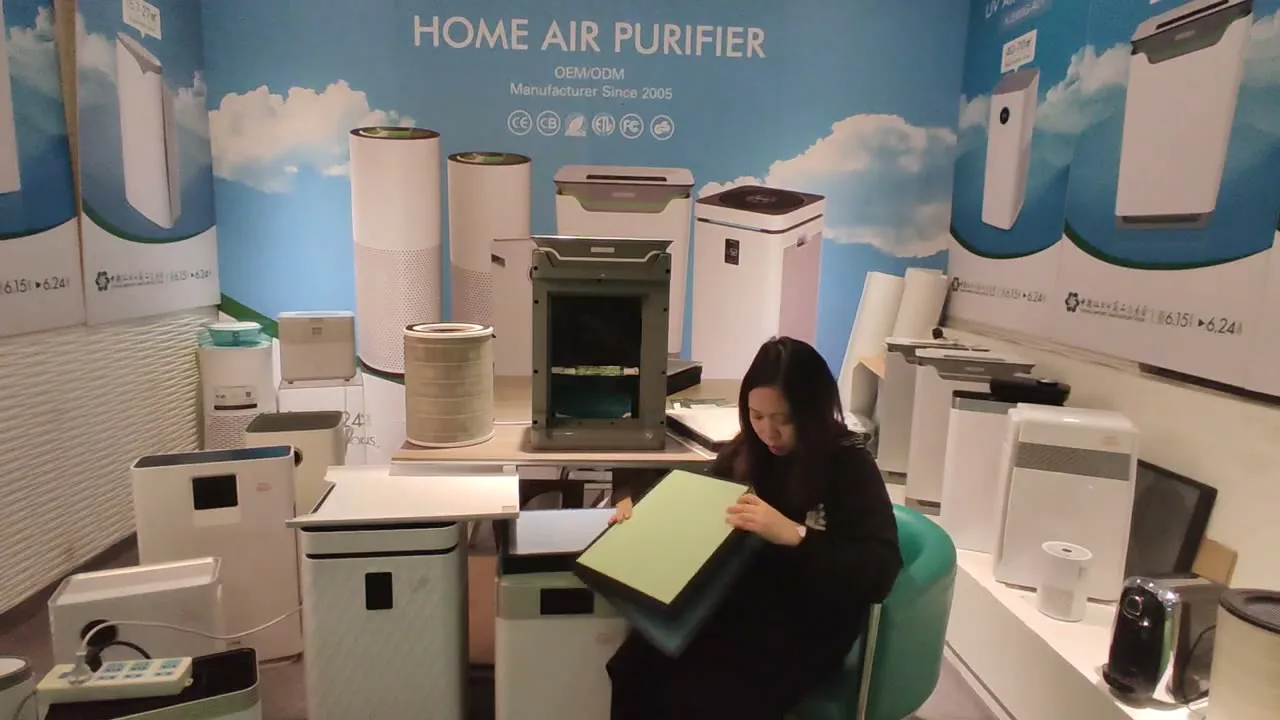
Filter count follows airflow, not marketing. A dual-intake chassis pulls air from both sides, so it carries a filter on the left and the right — that is how a mid-size body reaches CADR numbers a single-filter design can't. When we engineer a platform, the filter stack is sized from the target CADR and coverage area backwards (see how CADR translates to room size), then the media grades are chosen to hit it without pushing noise past 50 dB on the working speed.
What this means for your OEM program
- The stack is configurable per SKU. Grade, carbon fill weight, catalyst layer and antibacterial treatment are tuned to your market's brief — a pet-positioned US SKU and a formaldehyde-positioned Middle East SKU should not carry the same filter.
- Replacement economics are part of the design. Because our filter division is in-house (2M sets/year), the consumable is engineered as a product, not bought as a commodity — your margin on year-two replacements is stable, and the media spec can't silently change underneath your brand.
- Test data maps to the filter, not just the machine. CADR and CCM endurance reports reference the exact filter configuration, so what you certify is what your customer replaces.
Speccing a filter stack for a new SKU? Send the market brief — target room size, positioning claim, noise ceiling — and we will propose two or three configurations with the cost and CADR trade-offs laid out. Talk to our filter engineering team, or browse the filters & consumables program first.
References
- US EPA — Guide to Air Cleaners in the Home (how filtration technologies are classified)
- AHAM Verifide — verified CADR ratings and room-size methodology